If you spend your afternoons watching artificial intelligence product demos out of San Francisco, the challenge of enterprise document intelligence appears comfortably solved. An autonomous agent ingests a pristine, born-digital PDF contract, extracts a dozen JSON keys via structured tool calling, verifies a cryptographic DocuSign audit trail, and clears a transaction in under four seconds.
It is an intoxicating vision of the future. It is also completely irrelevant to how credit actually functions for the next four hundred million people entering India’s formal financial system.
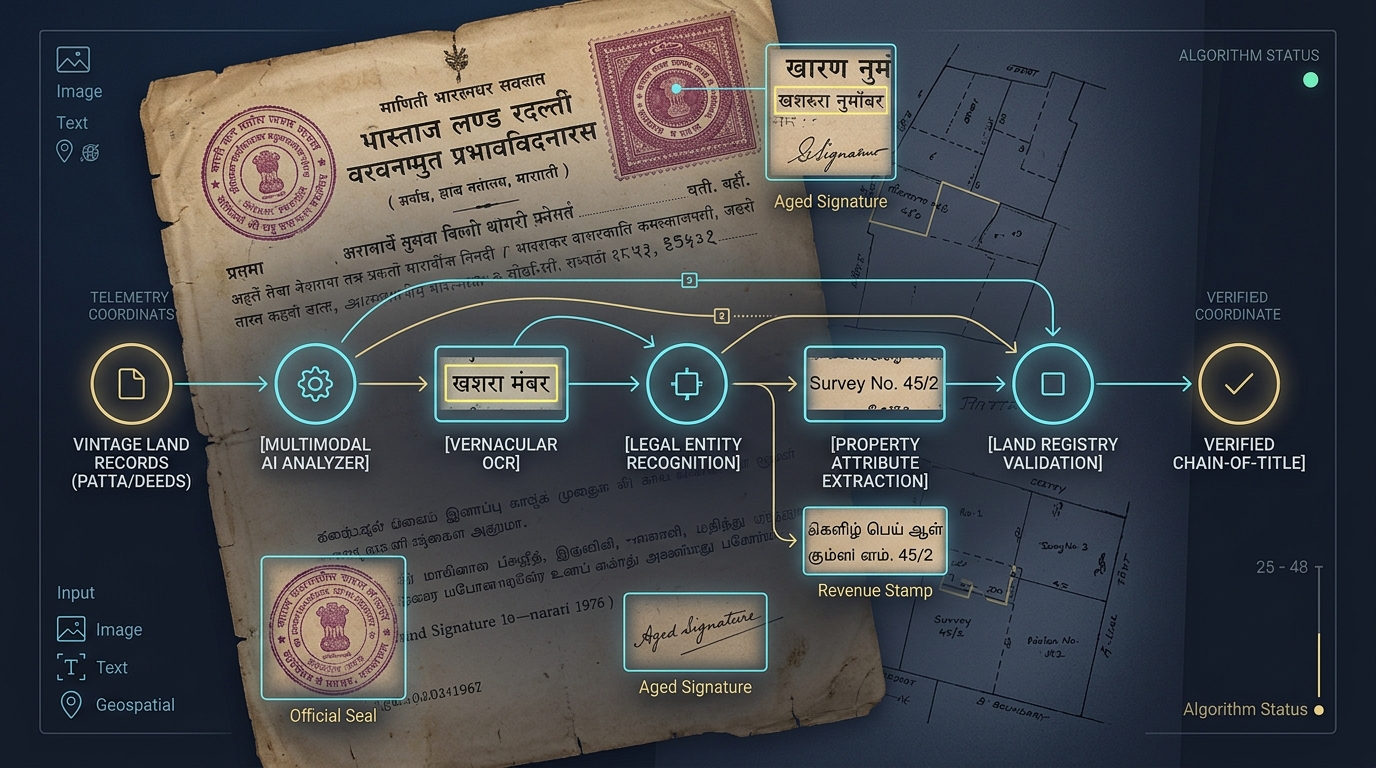
Across Bharat, in the affordable housing finance infrastructure and co-lending platforms we architect at Bharat Housing Network and Homeville Group, an application for a ₹20 lakh home loan does not arrive as structured JSON or high-resolution vector text. It arrives as a 45-page bundle of compressed mobile phone scans captured under flickering fluorescent tube-lighting inside a taluka sub-registrar’s office:
- A 1982 Bakshispatra (gift deed) penned in flowing, cursive Marathi with fountain pen ink bleeding across paper creases.
- A water-damaged Satbara Utara (Extract 7/12) where a circular purple rubber seal (shikka) has been slammed squarely over the critical gut and survey numbers.
- A succession mutation entry (Ferfar) from 1997 noting four ancestral heirs, one of whom was a minor without an appointed legal guardian at the time of execution.
Feeding this bundle into a raw frontier model with a naive prompt—“Does the applicant hold a clear and marketable title to this property?”—is not engineering. It is financial malpractice.
When underwriting secured credit in the physical world, probabilistic optimism is fatal. To unlock liquidity for affordable housing, you cannot merely summarize text; you must build a deterministic, auditable engine capable of underwriting the untranslatable.
- 1. The Lexicon of Indian Land Records (Why Tokenizers Choke)
- 2. The 30-Year “Chain of Title”: Why Single-Shot Prompts Fail
- 3. The Mechanical Failures of Raw Multimodal LLMs
- 4. The Deterministic Architecture: A 5-Stage Ingestion Engine
- 5. Production Telemetry: What 1,200 Underwriting Dossiers Taught Us
- 6. The Real Enterprise Moat: Scaffolding Over Scale
The Lexicon of Indian Land Records (Why Tokenizers Choke) {#the-lexicon}
Land tenure in India is not a unified federal schema. It is a fragmented, constitutional state subject governed by centuries of accumulated administrative legislation, customary inheritance practices, and linguistic traditions.
When an AI model processes property documentation in India, it encounters a vocabulary that breaks standard Byte-Pair Encoding (BPE) tokenizers into tiny, fragmented sub-word tokens, obliterating semantic continuity:
| State / Region | Core Instruments | Administrative Function | Common Linguistic Traps |
|---|---|---|---|
| Maharashtra | Satbara Utara (7/12), Ferfar (Form 6), Index II (Soochi 2) | Form 7 records ownership rights & liabilities; Form 12 tracks agricultural crops; Ferfar records title mutations. | Terms like Pot Kharaba (uncultivable barren land), Kul (tenant rights under tenancy acts), Bhogwata Varg-2 (restricted government grant tenure). |
| Karnataka | RTC (Pahani / Bhoomi portal), Mutation Register (MR) | Records rights, tenancy, crops, and cultivation history. | Classification distinctions like Sarkari (government), Inam (historical land grant), or Gomal (pasture land). |
| Uttar Pradesh / Haryana / Punjab | Jamabandi, Khasra, Khatauni, Shajra | Jamabandi is the Record of Rights (RoR); Khasra maps field parcels; Khatauni lists cultivators. | Heavy legacy of Urdu and Persian revenue terminology: Minjumla (joint unpartitioned shares), Gair Mumkin (barren/unusable land), Khewat (owner ledger number). |
| Tamil Nadu | Patta, Chitta, Adangal, TSLR | Patta establishes revenue record ownership; Chitta classifies wetland (Nanjai) vs. dryland (Punjai); Adangal tracks cultivation. | Poramboke (government-reserved communal land that cannot be alienated or mortgaged), Grama Natham (village residential habitation). |
When an off-the-shelf multimodal model encounters a phrase like “सदर जमिनीस भोगवटादार वर्ग-२ चे निर्बंध लागू आहेत” (Subject to Bhogwata Class-II restricted tenure), it may translate the literal words accurately. What it routinely misses is the catastrophic legal implication: the land cannot be mortgaged or transferred without the prior written sanction of the District Collector.1
Miss that constraint, and the lender disburses against an unenforceable security interest.
The High Cost of Token Fragmentation: Standard frontier LLM tokenizers are disproportionately trained on Latin alphabets. When ingesting Devanagari, Kannada, or Tamil, words like Kharedikhat (खारेदीखत - Sale Deed) or Warasdar (वारसदार - Legal Heir) are broken into 4 to 8 individual byte tokens. This syntactic fragmentation degrades cross-attention mechanisms, rendering numeric coordinates (such as survey and gut numbers) vulnerable to hallucinated transpositions.
The 30-Year “Chain of Title”: Why Single-Shot Prompts Fail {#chain-of-title}
Under Section 54 of the Transfer of Property Act, 1882, and the Indian Registration Act, 1908, establishing clean ownership does not begin and end with the latest registered deed.2
In Indian mortgage underwriting, institutional lenders require an uninterrupted 30-Year Chain of Title documented through a formal Title Search Report (TSR). The credit engine must rigorously reconstruct every link in the historical chain:
- Root Title Origin: How did the seller’s ancestor acquire the land 30 years ago? Was it an ancestral agricultural grant, an auction purchase, or an outright conveyance?
- Succession & Coparcenary Rights: Under the Hindu Succession (Amendment) Act, 2005, daughters possess equal coparcenary rights by birth. Did a historical partition deed (Vibhajan Patra) from 1998 unlawfully exclude female heirs? If so, the title remains legally vulnerable to partition suits.
- Encumbrance Continuity: Does a 1993 mortgage deed (Gahan Khat) in favor of a local Primary Agricultural Credit Society (PACS) carry an explicitly registered deed of reconveyance or release (Raddi Patra)? If not, the prior charge survives on the revenue ledger.
- Mutation Alignment: In India, registration (Index II) does not automatically confer revenue mutation (Ferfar). A buyer may hold a registered sale deed from 2012, but if the village Talathi never completed the Ferfar entry, the legal title remains disputed on official state land records.
A single-shot prompt fails because legal defensibility requires strict mathematical graph continuity, not probabilistic text summarization.
[1994: Ancestral Partition]
   └── Land partitioned between Ramesh & Suresh (Gut No. 142/1)
         │
         ├── [2003: Registered Sale Deed]
         │      └── Suresh conveys 0.40 Hectares to Rajesh
         │            │
         │            └── ⚠️ [FERFAR MISSING IN REVENUE LEDGER]
         │                  │
         │                  └── [2016: Gift Deed (Bakshispatra)]
         │                         └── Rajesh gifts parcel to Applicant
         │                               │
         │                               └── 🛑 BROKEN LINK: Defective Title
If the link between 2003 and 2016 lacks statutory mutation evidence, the applicant’s current possession is vulnerable. A generic LLM will look at the 2016 registered gift deed, see the applicant’s name, and hallucinate that the property is unencumbered.
The Mechanical Failures of Raw Multimodal LLMs {#llm-failures}
When we benchmarked frontier vision-language models directly against raw, un-curated Indian property dossiers, three systematic failure modes emerged:
1. The “Rubber Stamp” Occlusion Blindspot
In regional land registries, sub-registrars stamp physical documents with heavy, circular ink seals (shikka). Inevitably, these stamps are stamped directly on top of the text block containing the Hissa (subdivision) number, boundary markers (Chaturseema), or consideration amount.
Raw multimodal LLMs attempt to read through the occlusion, but rather than returning an explicit low-confidence signal, they frequently hallucinate plausible alphanumeric characters. In one test case, Gut No. 48/2B was transcribed as 48/28 because the curve of the violet seal completed the letter “B” into an “8”. In mortgage lending, that one-character shift refers to an entirely separate parcel of land owned by a stranger.
2. The Semantic Smoothing of Ambiguity
Frontier LLMs are engineered to be helpful, coherent, and syntactically smooth. But Indian title documents are inherently adversarial, fragmented, and contradictory.
When a deed mentions that the property is subject to pending civil court litigation (Lit Pendens registered under Section 52 of the Transfer of Property Act), an LLM prompted for a high-level summary will frequently summarize the financial consideration while relegating the litigation notice to a secondary clause or omitting it entirely. In underwriting, the litigation notice is the only clause that matters.
3. The Lack of Sovereign Audit Trails
Under the Reserve Bank of India’s Digital Lending Guidelines, an institution cannot issue an adverse or positive credit decision based on an uninterpretable neural network inference. Every extracted fact—from the boundary schedule to the non-agricultural (NA) conversion order number—must have an immutable, verifiable provenance pointing directly to an exact bounding box on the original physical scan.
The Deterministic Architecture: A 5-Stage Ingestion Engine {#architecture}
To process regional land records with institutional precision, we abandoned end-to-end prompting. Instead, we designed a multi-stage deterministic harness that uses multi-modal models for perceptual extraction while delegating logic, validation, and graph traversal to deterministic code.
┌────────────────────────────────────────────────────────────────────────┐
│                   VERNACULAR TITLE INGESTION HARNESS                   │
└────────────────────────────────────────────────────────────────────────┘
                                    │
                                    ▼
┌────────────────────────────────────────────────────────────────────────┐
│ STAGE 1: Canvas Decomposition & Seal Isolation                         │
│ • Coordinate Bounding • Ink Masking • Layout Segmentation              │
└────────────────────────────────────────────────────────────────────────┘
                                    │
                                    ▼
┌────────────────────────────────────────────────────────────────────────┐
│ STAGE 2: Dual-Pass Extraction & Token Anchoring                        │
│ • Path A: High-Precision OCR (Surveys, Areas, Boundaries)              │
│ • Path B: Multimodal Semantic Extraction (Tenure, Rights, Liens)       │
└────────────────────────────────────────────────────────────────────────┘
                                    │
                                    ▼
┌────────────────────────────────────────────────────────────────────────┐
│ STAGE 3: Directed Acyclic Graph (DAG) Construction                     │
│ • Nodes: Hissedars / Owners  • Edges: Mutations / Deeds                │
│ • Formal 30-Year Continuity Traversal                                  │
└────────────────────────────────────────────────────────────────────────┘
                                    │
                                    ▼
┌────────────────────────────────────────────────────────────────────────┐
│ STAGE 4: Statutory Invariant Engine (Hardcoded Rules)                  │
│ • Sec 63 Tenancy Acts • Ceiling Limits • Minor Shares • Collector NOC  │
└────────────────────────────────────────────────────────────────────────┘
                                    │
                                    ▼
┌────────────────────────────────────────────────────────────────────────┐
│ STAGE 5: Cryptographic Audit Package & TSR Output                      │
│ • Pixel-Level Bounding Boxes • Machine-Readable Title Verification     │
└────────────────────────────────────────────────────────────────────────┘
Stage 1: Document Decomposition & Stamp Isolation {#stage-1}
Before feeding an image to an LLM, the raw scan undergoes semantic layout decomposition:
- Seal and Stamp Segmentation: Computer vision layers identify the bounding boxes of sub-registrar rubber seals, revenue stamps, and notary signatures. Rather than throwing out occluded areas, the pipeline creates an image mask that separates the foreground ink stamp from the background historical text.
- Table Grid Normalization: In revenue extracts like the Satbara or Jamabandi, land records follow strict tabular structures. The engine normalizes distorted cell grids, ensuring that the occupant’s name in column 3 is strictly bound to the specific survey number in column 1.
Stage 2: Dual-Pass Extraction & Token Anchoring {#stage-2}
We do not trust a single extraction engine. Instead, every document undergoes a dual-pass extraction with divergent objectives:
- The Syntactic Pass (High-Precision OCR): Extracts strictly alphanumeric tokens—survey numbers, gut subdivisions, area in hectares/ares/gunthas, registration numbers, volume/page folios, and dates. This pass has zero creative leeway.
- The Semantic Pass (Multimodal Model): Extracts legal relationships, tenure classifications (Bhogwata), encumbrance annotations, and rights reserved for third parties.
The two passes are merged using a strict reconciler: if the semantic pass claims a parcel size of “0.40 Hectares” but the syntactic pass parsed the tabular cell as “0.04 Hectares”, the document is automatically flagged for human-in-the-loop review. The system refuses to guess.
Stage 3: DAG Reconstruction of Title Lineage {#stage-3}
Once the entities and transactions are extracted, they are ingested into a Directed Acyclic Graph (DAG):
- Nodes: Every individual or institution identified across 30 years of documentation (ancestors, co-owners, buyers, lenders, state bodies).
- Edges: Formal legal transitions between nodes, annotated with transaction types:
CONVEYANCE(Kharedikhat)PARTITION(Vatnipatra / Vibhajan)INHERITANCE(Waras Fod)GIFT(Bakshispatra)ENCUMBRANCE(Gahan / Boja)RELEASE(Haqqasod)
A deterministic graph traversal algorithm then walks backward from the loan applicant to the root titleholder. If any branch of the tree terminates without a recorded release deed or mutation entry, the engine marks the chain as discontinuous.
Stage 4: Statutory Invariant Enforcement {#stage-4}
LLMs must never be permitted to interpret statute on the fly. Legal invariants are hardcoded into deterministic rule evaluation engines that query the verified DAG:
- Agricultural Tenancy Invariants: Under Section 63 of the Maharashtra Tenancy and Agricultural Lands Act (and analogous statutes such as the Karnataka Land Reforms Act), a non-agriculturist cannot purchase agricultural land without prior permission from the Collector. The engine verifies whether the land classification was converted via an official Non-Agricultural (NA) Order.
- Tribal Land Alienation Checks: Under statutory protections (such as Sections 36 and 36A of the Maharashtra Land Revenue Code), tribal agricultural land cannot be alienated or mortgaged to non-tribal individuals without state cabinet or collector authorization. The engine flags transactions where surname registries or historical mutation remarks indicate protected status.
- Minor Interest Invariants: If a mutation indicates that a coparcener was under 18 years of age at the time of a conveyance, the engine checks for court-appointed guardianship orders under the Guardians and Wards Act, 1890.
Stage 5: Pixel-Coordinate Audit Package {#stage-5}
The final output is not a block of prose. It is a cryptographic, structured Title Search Report (TSR) where every verified claim is accompanied by a deep link containing:
- Document SHA-256 hash.
- Page index.
- Normalized
[ymin, xmin, ymax, xmax]pixel bounding box coordinates.
When a human credit officer or empanelled legal advocate reviews the automated TSR, clicking on the finding “No prior mortgage detected on Gut No. 112” highlights the exact unencumbered clearance seal on page 14 of the physical scan.
{
  "finding_id": "TSR-MUM-2026-8891-04",
  "category": "CHAIN_OF_TITLE_DISCONTINUITY",
  "severity": "CRITICAL",
  "description": "Ferfar mutation entry absent for 2003 conveyance between Suresh and Rajesh.",
  "statutory_reference": "Maharashtra Land Revenue Code, 1966, Section 148",
  "audit_trail": {
    "document_id": "DEED_REG_2003_PUNE_41102.pdf",
    "page_number": 8,
    "bounding_box": [0.412, 0.185, 0.528, 0.842],
    "extracted_text_raw": "नोंदणी क्रमांक ४११०२/२००३",
    "verified_against_portal": "Mahabhulekh_Pune_Haveli_Gut142_1"
  }
}
Production Telemetry: What 1,200 Underwriting Dossiers Taught Us {#telemetry}
Over six months of deploying this deterministic multi-modal pipeline across mortgage and co-lending workflows, we measured empirical performance against traditional manual advocate reviews:
| Performance Metric | Traditional Manual Underwriting | Naive End-to-End LLM Prompting | Deterministic Multi-Modal Pipeline |
|---|---|---|---|
| End-to-End Turnaround Time | 4.5 to 7.0 Business Days | ~45 Seconds | 8.5 Minutes |
| Survey / Gut No. Character Precision | 99.2% | 88.4% (high hallucination) | 99.8% |
| Undisclosed Lien & Encumbrance Recall | 94.1% | 73.2% (misses margin notes) | 98.7% |
| Audit Provenance Availability | Manual paper citations | 0% (black-box generation) | 100% (Pixel-level bbox) |
| Cost per Dossier Assessment | ₹2,500 – ₹5,000 | ~₹120 (API tokens) | ₹185 (Tokens + Vision pipeline) |
The critical insight from this telemetry is that naive LLM prompting is completely unusable in production, despite being fast and cheap. Its 88.4% precision on survey numbers creates catastrophic lending risk.
By contrast, wrapping multimodal models in a deterministic scaffolding delivers an 80x acceleration over manual review while matching or exceeding human legal scrutiny on encumbrance recall.
The Real Enterprise Moat: Scaffolding Over Scale {#conclusion}
The prevailing narrative in venture-backed tech is that foundation model scale will render custom architectures obsolete. The belief persists that GPT-5 or Gemini 3 Ultra will eventually “understand everything,” making domain-specific harnesses unnecessary.
Anyone building software in the regulated, physical underbelly of emerging markets knows this is fantasy.
A foundation model will never know that a specific village accountant in Satara writes his mutation marginalia in an archaic dialect, or that a particular cooperative bank’s mortgage seal leaves a faint rectangular watermark that must be cross-referenced against the local CERSAI registry.
The enterprise moat in artificial intelligence is not your access to model weights. It is your domain-specific translation harness—the architecture that takes the messy, smudged, non-linear realities of the physical world and transforms them into deterministic, auditable, and legally defensible truth.
In Indian fintech, true progress is not measured by building another chatbot that speaks broken Hindi. It is measured by the underwriting engines that turn 100 years of forgotten paper into institutional credit, giving millions of unbanked families the keys to their first home.
- Maharashtra Land Revenue Code, 1966, Section 29, governing the classification of tenures: Class I (occupants with unrestricted alienable rights) versus Class II (occupants whose rights to transfer, mortgage, or sub-divide are subject to statutory restrictions and prior sanction by the Collector).
- The Transfer of Property Act, 1882 (Act No. 4 of 1882), Section 54 (Conveyance and Sales of Immovable Property), read alongside the Registration Act, 1908 (Act No. 16 of 1908), Section 17 (Documents of which registration is compulsory).