Archive for the ‘gyaan’ tag
United WE stand
What brings a community together? What really binds the members of the community?
Two things: Pride and Fear.
3 idiots & i-become
I read Chetan Bhagat’s novel, enjoyed it … but sadly the book lacked a certain message. It’s either that or it’s been 3 years and I dont remember the book very well. 3 idiots is a stark contrast.
The basic plot is the same, but once you go in the details, both the stories are distinctly different.
One of the central themes of the movie is about following one’s passion. To aim for excellence and not for ability. The scene where Aamir Khan talks about being well educated and not well trained is a must see. I can really identify with that, since its very much related to a vision that I am currently working on.
This is i-become.
i-become is about realizing your career not as a place just to earn money, but as a place for following one’s passion by utilizing one’s full potential. The way Madhavan decides to follow his passion for Wildlife photography, so should each one of us aim for our aspirations. Without a purpose, a goal, an aspiration … life is nothing but a empty shell.
What do you think?
Nirvana or Selfishness?
At a common friend’s wedding, a friend and I had an interesting discussion on nirvana. The discussion started from the idea of how does one go about becoming inside-out. Prompt came the answer from hom, that one should not take external factors into consideration. One should act because one wants to and not because it has been forced on someone. I have known him for a decade or so now, and I think he really practices what he preaches. The problem with that reasoning is that sometimes an individual is not just responsible for himself, but has other obligations (family, job, friends, etc). This binding to the society ties us to worldly problems.
For this reason, when an individual seeks to move towards nirvana, he first needs to take the consent of his family. This consent gives that person a freedom to be inside-out. That act cuts off his liabilities, and he can then transcend to a truly enlightened individual. A person who chooses to do so without the consent of his family and dependents, is merely a selfish person who chooses to ignore them.
PS – not gyaan, but just an observation.
Godfather: A Collaborative framework
If you have read Mario Puzo’s Godfather, then there is a lesson to be learnt on Knowledge Management. Don Corleone knew the best methods of collaboration. One of the first scenes in the book is when a pall bearer comes to the Don with his problem. The Don welcomes him with open arms, and listens to his problems. Then he chides him about not coming earlier and most importantly not recognizing Don as his friend. He accuses the man of becoming the Don’s friend only in the time of need. Then he solves that man’s problem. The same guy comes to the Don’s use when his own son (Sonny) needs a proper funeral. But that’s not the point of this post, is it.
Successful collaboration between multiple people requires – co-operation amongst the people who have proper skillsets. Don Corleone knew whom to choose for which task, and how to get it done.
Web 4.0: The Enabling Web
Forgive me, this post is going to be a long one.
In the brief span of its existence, the web has evolved at such an alarming rate, that it outstrips evolution of any living organism. Even as Indian web users and web development companies are creating (and using) Web 2.0 platforms, the more developed nations are already talking about Web 3.0, the semantic web.
Not so surprisingly, I have found to my chagrin that 80% or more of the Indian populace associate Web 2.0 with client side technologies instead of a collaborative technology. People associate it with all the wrong ideas … I do not blame them. Awareness has always been the bane of comprehension. Having said that, I decided that it would do some good if we can somehow capture the evolution of the internet in these already popular phrases, and somehow manage to extrapolate what the next stage could be – so that we are prepared when it comes
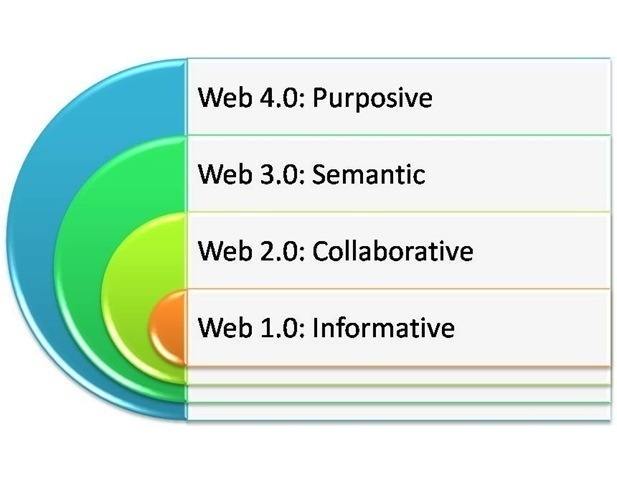
Or even better, a host of Indian companies could bring in the era of Web 4.0: The Enabling Web. So what are these evolutionary milestones?
Web 1.0: The Information Superhighway
This is the internet of yore. Those were the days when people would make separate HTML pages and upload it on the net. Content was written within these pages and uploaded. It was authoritative in nature, since most of these sites were a one way communication stream. People came to different sites with the sole aim of gathering information – hence the name, the Information Superhighway.
Web 2.0: A Collaborative Medium
This is the internet that we see around us these days. The web is more social now, its a place to meet interesting people – to collaboratively create content. Content is not written within pages, content is created by the users themselves. The more the users, the more the content. What the developers create is a platform which enables this co-creation between the users. A great example of this is Wikipedia or IMDB.
Web 3.0: A sense making layer
The new era of internet is coming, this can somehow make sense out of the user’s inputs and act accordingly. So when I say “Show me a blue lotus”, the internet should show me the image of a blue car instead of a blue flower. How does it do this? It already has my preferences for cars over flowers somewhere. This is where collaborative filtering mechanisms and business intelligence algorithms are used to correctly profile the user. The internet is capable of understanding what the user is speaking. It differentiates a Gandhi from a Hitler. Some examples of this would be WolframAlpha or Amazon.
Web 4.0: The Enabling Web
So what happens when the web begins the “understand” the user. The sole question is – “What’s the point?”. If it can understand the user, it can also understand the purpose with which the user is driven to visit a particular web application. And, if that can be done, then it won’t be too difficult to understand and provide what other resources would help the user reach his outcome. The web suddenly becomes a more intertwined place with each web application talking to others, so as to provide the best experience to its user. Not only experience, but to ensure that the user is enabled with the right set of resources to get his job done. The purpose of the user is kept at the center. That’s my vision for web 4.0 akin to a more evolved Ubiquity extension of Firefox.

Co-ordinate Geometry and Perspective
This is going to be a philosophical post, don’t say that I did not warn you at the beginning. But, I have came across an a-ha! for myself at work. This just does not apply simply to Good v/s Evil, but it can be applied to life itself.
Good and Evil are two sides of the same coin, that means, if I were to have an axis (similar to say X-axis), then Evil will be on the left hand side of the Y-axis and Good will be on the right hand side. Thus, Good and Evil are opposites. Now, my friend, what do you do to eliminate Evil? Think. Don’t move ahead and read the answer, please think. Think Co-ordinate Geometry.
You delete the origin (0,0), you take out the Y-axis. You take out the definition point at which Good starts being Evil. You take out that Evil-defining-perspective (Y-axis). I am defining each axes as a perspective on life, and thus, a way of defining (aka constraining) your perspective. Take out the Y-axis and now you have only a degree of Goodness left.
Now, ask yourself – what happens when you take away the X-axis? That translates into a change in your perspective. A shift which fundamentally changes the way you look at things, look at the world. How much more of the co-ordinate geometry concepts can I apply on this? Does this make sense to you? Would appreciate some feedback on this.
Uncertainty
I had gone to a friend’s place today to see his new born baby. Babblo* has a cute little daughter – I hope she doesnt take her looks from her dad!
So we got talking as friends do when they meet after a long time. Our favorite “R” word did come up. and so did the job switch. I see so many people who do not love their jobs, that I wonder has anybody written a paper on this? (let’s figure that out later)
This guy works for one of the big 4 consultancies, has been working with that firm for the past 4 years now. A job that any Systems MBA would kill for … yes, present company included
But I know the hours are long and the gyaan is hot. It requires the sheer dedication that dissolves my resolve to get into a post like that. Again, this is not the point, moving on …
Babblo’s reason for wanting to switch is that he does not see himself becoming one of the head honchoes and top guys in the next 5-6 years. He see himself reach the middle echelons of the organization, but still sees miles to go before he sleeps. Hence, the idea of moving out and getting into a different vertical altogether. A new stint even a startup. Have you imagined a guy who eats, sleeps, breathes ITIL trying to get things done in a startup? A comic strip on these lines can rival Dilbert
. Moot point being that Babblo (of course its not the true name!!) is actually turned off by the certainty of the job.
I cant identify with this funda. I for one would love some certainty on knowing what I will be doing 5-6 years down the line. Its easy to bluff, but do I really KNOW what I will be doing … hmmmmm … web surely, technology definitely, startup – could be, big hulking monolithic organization – sure why not, just pay me well!! I don’t know which is better – the certainty or the uncertainty!
Vision
I am not going to throw up corporate gyaan into your face. Today I met up with a very good friend of mine; over a cup of coffee, he tells me – I have a vision. A 2020 vision.
Upon hearing this I went into “corporate mode”; with the mission, vision thingy … before I could dwell any more deeper into those buzzwords, Nikhil stops me. He tells me that he has no idea what jargon I was spewing, but he has a clear well defined vision towards which he intends to work. The manager within me came forth and suggested that maybe he should outline a plan and start reaching towards that goal, since at the moment he did not have a clear idea as to how he is going to get there.
But what impressed me is that he had a vision. How many of us have a vision about what we want to do in 2020?
Then and Now
My first job was in IRIS, in the year 2002. I loved my job. I had joined with seven other software engineers. We bonded really well together. We used to work on different projects, but lunched together … discussed problems, solved them … and generally helped each other out. Life was good, life was beautiful. I loved my life of a programmer. Our batch was one of the best the organization had, in fact some of us were awarded as the most valuable programmer, et al. No, I am not being modest
, but we loved helping each other out … contributing to the organization.
My last job was in I2I. It was a simple transaction for me. I went to work, I stayed there till 6.30pm everyday, I came back – the company paid me for it. The very transactional nature of this perspective made me shudder … I had to leave the organization in search of greener pastures.
My new job is with Illumine, where the culture of the organization is to actualize the paradigm shift from transactional thinking of a job to contribution thinking. Will post more on this later, but at the moment think about it. Is your job a transaction for you?
Peace of Mind
Just the other day I was talking to Amol aka Baba. Our discussions can meander from technology to yoga to relationships, well to put in a nutshell, they makes you think (yes, its a philosophical post). So, the question that cropped up was – What is peace of mind mean to you?
Any takers? Well for me, peace of mind is the place where I don’t have to make any extra efforts to reach my destination. Further thinking led to the point that you can be en route to that destination and still have peace of mind, which I think could be the case when you know that in due course you are going to get there.
Baba later pointed out, that a person can feel uncertainty, anger, frustration, et al and still have his/her peace of mind. If the person knows the difference between his core feelings – the ones which help him achieve his id and his ternary feelings – the ones which can be dispensed off with i.e.. the anger, frustration, et al. But that person would have to be completed detached – a sadhu of sorts. That would be some person … well for one, his family would not be happy with this guy’s eternal cool.
Kind of reminds me of that Socrates’ incident, when his wife threw a bucket of water at him because he would not get into a fight with her. After which Socrates coolly said, “It seldom rains after the thunder”. Now that is peace of mind
, What say?